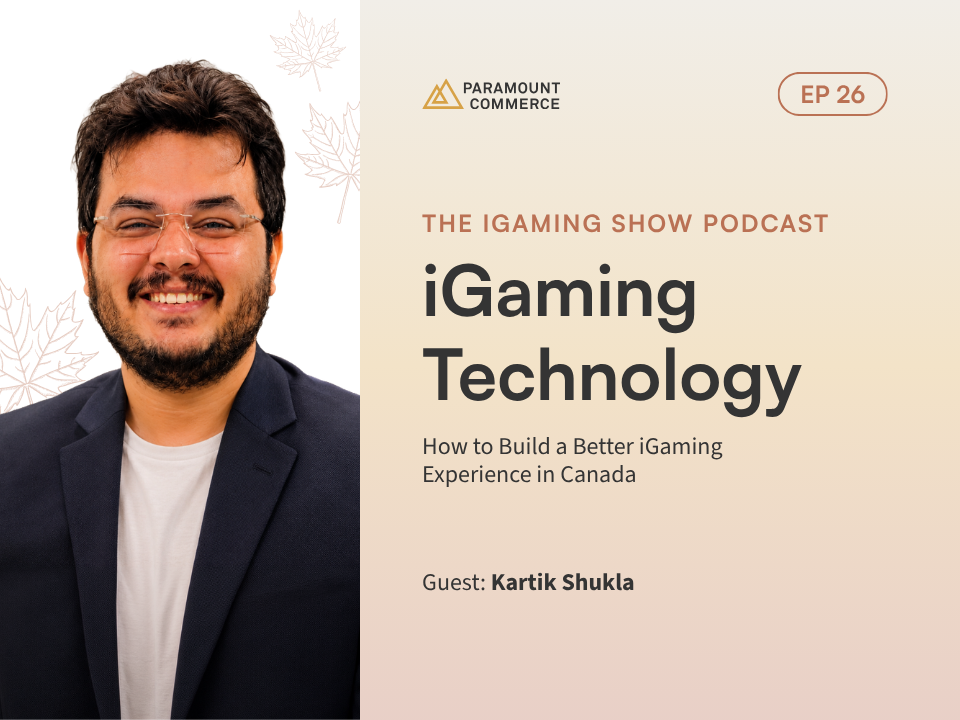


In this episode of The iGaming Show, we speak with Kartik Shukla, COO at Tecpinion about how operators can build scalable, localized iGaming platforms for Canada’s evolving regulated landscape. We look at Ontario’s established market and Alberta’s emerging opportunity, covering platform selection, launch readiness, player experience, compliance, and the role of trusted local payments.
Guest: Kartik Shukla, COO at Tecpinion
The iGaming Show, presented by Paramount Commerce, is a podcast that will analyze gaming industry trends with experts from various gaming organizations.
Read full episode transcript:
Varad Mehta: Whether it’s technology or understanding regulations, there are a lot of components that go into building an iGaming platform, especially in a regulated space.
To better understand the best practices, we spoke with Kartik Shukla, the Chief Operating Officer at Tecpinion. So sit back and enjoy the show.
Getting to Know Kartik Shukla
Varad Mehta: Kartik, we always begin this podcast by asking our guests a few fun questions. I have a few lined up for you.
The first one is: do you still have Virat Kohli’s autograph with you?
Kartik Shukla: Oh yes, I do. I still have that.
Varad Mehta: That’s cool. What’s the story behind it?
Kartik Shukla: This was a long time ago. I got into the hotel where the players were staying and actually met Rahul Dravid in the lift. I took his autograph.
Then, when I went up to the lobby, Virat Kohli was just going by. I stopped him and took his autograph. That was, of course, a cool moment.
I actually wanted Sachin Tendulkar’s autograph because he was still playing then. But they were very sweet. They all stopped. I didn’t have a camera to take a picture, so the best I could do was get an autograph.
Keeping Project Management Simple
Varad Mehta: My last fun question is about something you once wrote. This is a quote from you: “I’m completely convinced by my belief that project management is nothing but simplicity. Make things simple and the rest will fall into place.”
Do you still stand by that statement as a COO?
Kartik Shukla: Absolutely. I do that every single day. The more complex I make things, the tougher they get later.
I’ll give you an example. I was making a perpetual storage solution. Perpetual means literally perpetual. There was a certificate involved and a lot of other things.
How did we make it perpetual? Just remove the delete button and don’t write a delete command. It was that simple.
There was a lot of thought going into it, with people and clients spending hours on it. I gave them one idea: there is no delete trigger and no delete button. That will solve your problem.
They weren’t able to understand what I meant at first, but that’s how simple it was.
Varad Mehta: Sometimes the simplest things sound the most insane.
Kartik Shukla: Of course. It happens a lot. It has happened to me many times.
Ultimately, that experience is why I wrote that. First, go to the simplest solution. Only if you’re not able to solve it, or there are other things surrounding it, should you go to the next stage.
Varad Mehta: Love it.
What You Need to Launch an iGaming Platform
Varad Mehta: Moving into our topic of discussion, we’re here to talk about Tecpinion and the best practices for setting up an iGaming platform.
For someone launching a new iGaming brand in Canada, in a regulated market like Ontario or Alberta, what are the core technology components needed to move from an idea to a live platform?
Kartik Shukla: If somebody wants to launch a brand, there are multiple things to consider.
The most important component is something we work on: PAM. Some people call it player access management, and others call it player account management. There are various names.
The concept is that this is the technology that holds the entire infrastructure together.
On top of the PAM, we add game aggregation, game applications, and game providers. Those could also include an operator’s own games. Some clients and developers come to us with games they want to integrate.
Then, of course, there are payments, deposits, withdrawals, and everything related to them.
With payments come compliance requirements, KYC, geolocation, age restrictions, and everything connected to those areas.
Then there is infrastructure. Where are these applications hosted? How do people join? How many people join? If 100,000 or a million people join, can the application support them?
This whole ecosystem makes up the components required for an operator to create an iGaming brand.
White Label vs. Turnkey vs. Bespoke Platforms
Varad Mehta: Can you explain the difference between a turnkey, white label, and bespoke iGaming platform? When is each approach most appropriate?
Kartik Shukla: It’s mostly a business decision.
Let me start with white label. White label is usually for operators who are trying to test a market. You have a system where everything is already there. They take a small tenant space, start their operations, and see how their games grow.
Then there is turnkey. A turnkey solution is a little more customised than white label. There is more thought behind the business and some customisation involved.
For example, there may be additional third parties to integrate. Operators may have their own games or games from people they work with that they want to include.
Bespoke is a fully customised solution. The operator knows exactly what they want and gives us their specifications.
For example, they may not want the usual sign-up process. They may want a different sign-up experience or a different flow for a user to buy a coin. Those kinds of requirements fall under bespoke.
Launch speed is also a major factor.
White label is very fast because you’re changing a few colours, the logo, and similar elements. It takes a very small amount of time, but customisation is limited. We also say that it doesn’t support too many users.
Turnkey is another relatively fast solution, but customisation means it takes longer. There is usually an agreement between us and the operator. Customisation is higher, and the operator has a little more control over the technology.
With bespoke, the operator’s specifications are addressed individually: their system, how they want to take care of players, and how they want the overall platform to work.
The launch takes longer, customisation is higher, and control over the technology is higher. Everything is based on their requirements from the beginning.
We always say one thing: don’t choose a platform based only on how quickly it can get you live. You also need to consider control, flexibility, and how you want to run the business. There can be different business cases.
Varad Mehta: It depends on their needs, basically.
Kartik Shukla: Exactly.
White label is for new entrants. Turnkey could be for people who have tested the business or already understand it.
A lot of people come to us for turnkey because they’re part of a bigger organisation and understand the business. They want to launch their own business without spending too much.
Bespoke is often for operators who are very clear about their business. They may have already gone through white label or turnkey, and now they want everything built around their requirements.
Mostly, established businesses come to us for bespoke.
Why Early Integrations Matter
Varad Mehta: That’s important to understand because these are the different ways platforms are set up.
You also spoke about integrations. Why are integrations such as player account management, game providers, geolocation verification, and responsible gaming tools so important to consider early?
Kartik Shukla: That’s a very good question.
We talk about PAM a lot because that’s what we specialise in. But all these integrations—whether it’s a responsible gaming tool, payment provider, game provider, server setup, or DevOps operation—are not disconnected from the system. They are part of the PAM.
We could call the PAM the soul of an operator’s app. The integrations are like the eyes and hands, and the ways data passes through the brain.
I’ll give you an example. Ontario has a centralised self-exclusion system, BetGuard. Along with that, operators also have to have their own responsible gaming tools.
Alberta has its own regulatory requirements as well.
These regulations need to be part of the process early on. If we keep pushing them ahead, we will eventually have to rework things. We’ll have to revisit a lot of the code, which can cost the operator a lot of money.
That’s why we always suggest considering these things very early when operators are setting up their applications.
When operators come to us, we explain the different things they need and suggest what they should start with.
For bespoke operators with additional requirements, we study those requirements with them. They’ve studied their business, and we study it alongside them. This happens very early in their lifecycle.
Designing the Player Experience for Ontario and Alberta
Varad Mehta: Going back to business needs, how should operators think about the player experience in markets such as Ontario and Alberta?
Ontario has been established for a few years, while Alberta is new. What does that look like according to you?
Kartik Shukla: There are three things we need to focus on.
I have some figures. In 2024–25, wagers in Ontario hit somewhere around $82.7 million Canadian, and revenue was somewhere around $2.9 billion. That’s a big number considering how quickly they reached that revenue.
There were around 2.6 to 2.7 million player accounts, I think. Revenues were also crossing about $2.6 million for most of the operators, if I put it that way.
Another big point is how many people actually use the app regularly. There are 83.7% active players, which is a big number.
Considering all of this, the first thing I would focus on is localisation.
We need to understand the market: player expectations, payment providers, and how the regulatory body treats these things. There may be different rules in Ontario and Alberta. That’s one of the major points.
Then there is performance. By performance, I mean the performance of the software and the app we are building. How fast is it?
The user should not feel any lag when signing up. When they make a payment, it should immediately reflect in their wallet. All of those things are very important.
Then, of course, there is data. Everybody needs to include this in their business plan. They need to use analytics, AI and machine learning methods, or their own methods to understand and study these areas.
Coming to the Alberta market, I think it was July 13, 2026, when it launched. A lot of unregulated operators are already in that market.
As it becomes regulated, some will be filtered out of the system. Others will work towards meeting the regulations and addressing the points I spoke about: localisation, application performance, and analytics.
Creating a Seamless Payment Experience
Varad Mehta: As a payment service provider in Canada, we know at Paramount Commerce that payments are an important part of the overall iGaming experience.
Payments are often the last thing players see but one of the first things they judge about an iGaming platform.
What makes that payment experience feel secure, familiar, and seamless for Canadian players? What are the best practices?
Kartik Shukla: Here, too, I have three points.
The first is convenience and familiarity. The payment methods should be familiar to the user. They should be able to pay and deposit easily and quickly. They shouldn’t need to relearn everything.
The second is security and transparency. Every transaction should be transparent to the user, and the experience should show that it is secure.
When that happens, users are happy and feel comfortable coming back.
One of the most important things I’ve come across is withdrawals.
Every player wants to be able to withdraw. If that process is difficult, it affects how they see the entire gaming experience. They may use the platform once, but when a withdrawal fails, that’s when they say, “This is not a reliable system.”
For me, that’s a very important point.
I feel that payment partners like Paramount Commerce can help deliver that experience because I know Paramount Commerce has some excellent methods for Canadian players.
Choosing iGaming Technology: Best Practices and Mistakes to Avoid
Varad Mehta: My last question, Kartik, is about creating a checklist.
What are the best practices when choosing iGaming technology? What are the common mistakes operators should avoid?
I’d also love to know what the Tecpinion team is working on for regulated markets in Canada or elsewhere.
Kartik Shukla: I’ll start with a few things.
The most important point is the operator’s own business. They need to understand why they’re stepping into the business.
As I mentioned, they need to decide which model they’ll go with: white label, turnkey, or bespoke.
They should have long-term plans—at least a five-year plan—in mind. That’s very important from a technology perspective as well. The roadmap ensures that we follow the right technology direction.
Then comes platform architecture. That’s something we can help with. Our platforms support more than three million players across North America, and those users deal with these things daily.
Coming back to technology, we should ensure that we follow a microservices-based or headless architecture. That’s technical, but considering the number of people coming into the system, it’s something we need to understand.
Then there is data ownership and portability. Who will own the data? If somebody wants to switch providers, how will that happen?
The PAM has all the data, so operators need to understand how that data will be handled when changing providers.
Security and regulatory requirements are very important. They should be part of the checklist. This includes payment providers, KYC, and understanding how both work with the PAM.
Then there is flexibility. How flexible is the system if you need to change your business plan?
For example, if a sweepstakes platform wants to move into real-money gaming, how easy or difficult would that be?
These considerations should also be part of the technical team’s checklist. It’s a business decision, but the technical team needs to have these things in order.
Of course, there is also uptime. The application should not go down because of modifications or issues. Players should not feel that something has happened behind the scenes.
What’s Next for Tecpinion: Prediction Platforms
Varad Mehta: Is there anything your team is working on that you’d like to talk about? Any exciting developments?
Kartik Shukla: We are building our own prediction platform. That’s coming along nicely.
The evolution is pretty amazing. When we went into the iGaming business, it was largely about fantasy sports and sports betting. Those were the two main aspects.
Prediction has combined elements of both into a tool that operators are now using to engage users. They’re also using it for user acquisition.
For example, they can put small prediction games on different sites and newsgroups to bring users to their applications.
That’s something exciting we’re starting with.
AI and Machine Learning for Operators
Kartik Shukla: We’re also working heavily on the business side, using AI and machine learning methods to make it easier for operators to run their businesses.
They can get reports based on what they want. Every operator has a different way of running a business, and these tools give them what they need in their own way.
Those are two of the major things we’re working on.
Expanding into Healthcare Technology
Kartik Shukla: Another exciting area is something we worked on when we first started Tecpinion, and we’re going into it again: the medical side.
We’re working on an oncology cost intelligence platform to help users understand their costs.
An oncology patient is already going through a lot. This is an episode-based cost intelligence system that helps them understand the costs involved.
That’s another area Tecpinion is working on. Those are the three core areas we’re focused on.
Varad Mehta: Sounds like a busy time. I don’t envy you!
Kartik, thank you so much for joining us. Whether someone is starting a new platform or running an established one, understanding the available technologies and the best practices behind them is important.
Having an expert team like yours is vital to that effort as well.
Thank you for explaining all of this. It was really helpful, even for me. Thank you again, and we’ll chat soon.
Kartik Shukla: Thank you. Thanks a lot, Varad. It was great talking to you.
I had a good time. I like reflecting on these things. I went back, I came forward, and it was a good experience for me.
Varad Mehta: You’re debriefing right now. All the ideas are coming! Thank you again, Kartik.
Kartik Shukla: Thanks a lot, Varad.
Varad Mehta: With newly regulated spaces like Alberta and an established market like Ontario, getting the right iGaming technology is vital to building a presence in Canada.
I want to thank Kartik Shukla, the Chief Operating Officer at Tecpinion, for joining us and sharing his expertise.
If you have any questions for us or Kartik, please comment below. Don’t forget to like and share this episode and subscribe to our YouTube channel.
For the episode transcript, please visit paramountcommerce.com.
Thank you so much for tuning into The iGaming Show, presented by Paramount Commerce. I’m your host, Varad Mehta.
Until next time, keep gaming.
Fintech trends and insights,
explained in 5 minutes or less

Fintech trends and insights,
explained in 5 minutes or less