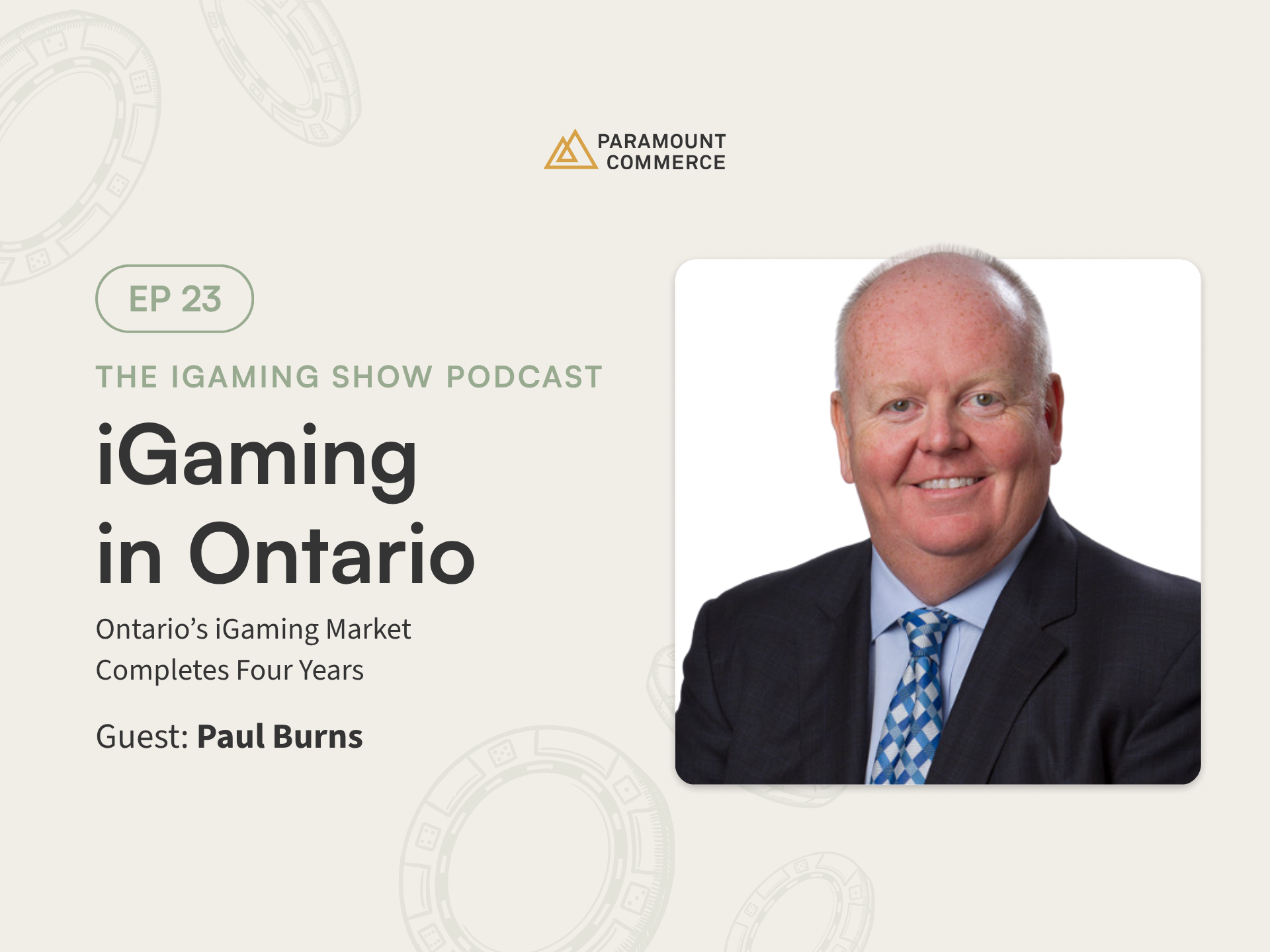


In this episode, we chat about Ontario’s iGaming market hitting the four-year mark, what we’re seeing in player behaviour, how consumer protection is evolving, and what it all could mean for Alberta’s upcoming regulated market.
Guest: Paul Burns, President & CEO at the Canadian Gaming Association.
The iGaming Show, presented by Paramount Commerce, is a podcast that will analyse gaming industry trends with experts from various gaming organizations.
Please like, comment, and share this video. Also, stay up to date with our content by subscribing to our YouTube channel.
Let us simplify payments for you today: https://www.paramountcommerce.com/book-a-demo
For pricing information, please visit: https://www.paramountcommerce.com/pricing
Learn about our Interac e-Transfer and Instant Bank Transfer solution
Full episode transcript:
Varad Mehta (VM): Whether it is the total amount of wagers placed or the annual revenue generated, Ontario’s regulated iGaming market continues to grow on a year-to-year basis. And to explore why this market is continuing to thrive, we spoke with Paul Burns, the President and CEO of the Canadian Gaming Association. So without further ado, please enjoy the show.
VM: So Paul, as you know, on an annual basis we do this and we always begin with a few fun questions. So I have two lined up for you this year.
Paul Burns (PB): Can’t wait.
VM: Yeah, the first one is, your family was in the coal business, if I’m not mistaken. How did being around that environment shape your professional career, and when did the coal business actually start?
PB: So the coal business started in Toronto in around the 1830s. I never saw the coal business by the time I came around. My father was sort of the last generation to—even as a kid, it started to disappear. But my great-great-grandfather, Patrick Burns, came from Ireland in the early 1830s, and when he got here, he created a coal and wood delivery business to homes in Toronto.
He had five or six yards around the city, and it was mostly delivered by horse originally. The business was around for well over 100 years. But it was really in the ’40s and ’50s after the Second World War that homes started to move to oil. I guess they didn’t think— I don’t know whether they thought oil was a passing fad. I’m not too sure how it went down at that point in time as the generations progressed.
I know that my grandfather was involved in the business, but a lot of his brothers weren’t. Two of them were in the military, and two of them were nuns, if I remember correctly. So it was a time when that business really didn’t evolve. My family connection to Toronto now goes back that long. And if they’d just held on to the real estate, it would have been great.
VM: Can you imagine? That is such an interesting side of your family that no one— I hope people know this about you, that you have such…
PB: You did some research, man.
VM: That’s so interesting.
PB: No one else has brought that up.
VM: I swear my last fun question for this segment will be: last year you attended the Calgary Stampede. So what was that like? What was that experience like? And have you attended the Stampede before?
PB: I hadn’t attended the Stampede in well over 20 years, but it is an amazing event only because of what it does. It brings the City of Calgary together. They open their city to the world and the country.
Not only are they celebrating their heritage and the cowboy culture and seeing the rodeo—the chuckwagon races are something everyone should see in person—but also the way the corporate world in Calgary just opens up. Everybody steps back and for 10 days it’s a lot of socialising and networking and a lot of fun. It’s a great way to meet people.
I probably ran into the Premier half a dozen times because she probably did 100 events in the five days I was there. As well as the provincial cabinet, Premier Scott Moe from Saskatchewan, Doug Ford was there, and the federal Prime Minister and cabinet were there for a few days. You go and everybody’s out and networking, and you get a chance to meet and talk to people.
It’s a great environment for people wanting to network, do business, and connect. I loved it. I had forgotten how good it was. I was last there when I was a political staffer—that was the last time I went. It was a busy time: an endless parade of events, barbecues, receptions, getting to see the chuckwagon races, and everything else.
Calgary’s Stampede area is evolving too: a new stadium for the Flames is being built, they’re adding hotels, and a brand new convention centre. It’s a great facility and a great area, so it’s a lot of fun.
VM: Now going into the topic of discussion, we’re here to talk about Ontario’s iGaming market turning four, and we always do this on an annual basis—a market checkup on what it looks like. My first question would be: the market ended on such a high note in December with millions and billions wagered. I read it had around 4 billion dollars in annual revenue. What do these numbers tell you about maturity and sustainability within Ontario’s regulated market?
PB: I think everybody can see that some people are surprised there’s still this number of operators in the marketplace and that the volume of business continues to grow. Part of that is recognising that customers are finding what they’re looking for.
That’s a testament to operators in the marketplace who continue to innovate, offer new product, deliver on customer service, and improve the way they serve customers. It’s a competitive marketplace and competition brings out the best in everybody, and that’s showing. That’s the encouraging part, and that innovation is going to continue to help it grow.
No one is resting on their laurels and saying, “We’re good.” Everybody is leaning in and working hard. That’s the testament. We’ve also seen growth in accounts in a modest way, but people are still finding good entertainment value. They enjoy the products they’re getting.
It all speaks to operators embracing the model, leaning in, and continuing to innovate.
VM: Speaking of that embrace, I was just looking at a report online that mentioned that when you look at how wagers happen, the biggest segment now is online casino. What does that say about Canadian player behaviour? And do you see this balance shifting further—more of the total wagers being completely online?
PB: I think there’s still a little bit of something for everybody in the gaming marketplace in Canada—from the retail side of in-person gambling in casinos, and there are lots of great ones across the country. We still need to make sure the regulatory framework and policies encourage the land-based business to offer their products to their customers both online and in person, and to create that omnichannel experience if customers want that.
That’s really important not to lose sight of, and governments need to make sure that happens. People are loyal to companies. There are lots of reward programmes and they like that. Being able to integrate those rewards into the online space will be very important for land-based success.
Ultimately, while people may love the online experience of playing table games or live dealer programmes, they do crave the social experience too. Being able to stay relevant in that in-person marketplace is going to be really important for the industry. It’s still a huge part of the business. All demographic groups will, at some point, spend time in a casino and enjoy that social experience.
The digital growth is reflective of the broader digital economy, which has disrupted many industries and forced change. But we all have to remember it’s about the customer. The customer is driving this. They like what they’re seeing, and they want that creation of experience.
There’s a lot of product in the market. Companies have to compete hard, not just with bonuses or incentives, but with the quality of product, the games they offer, and the experience in that digital environment. It’s exceptionally important that this works for customers because they do have choice.
We want policies and the regulatory framework to ensure that innovation can happen and thrive. There’s all kinds of innovation in product and new products will come along. We have to remain relevant to customers. Operators want to build loyalty through rewards, good service, and an ever-wider range of games and products.
VM: You mentioned the player experience and the offerings operators have. What do you see as some of the biggest contributors to increasing player adoption? I’m sure consumer protection also plays a role—consumers feel safe betting on a regulated platform. What are some core elements that really increase player adoptability?
PB: We’ve done some research, including channelization studies in British Columbia and Alberta last year, asking customers what they look for in a site and why they choose one site over another. There were no surprises. Any operator knows that friction is the enemy.
The lower the friction for the customer, the better: easy to deposit, easy to withdraw, easy to sign in. All those pieces are really important. Clear and transparent bonusing is something we hear customers really value.
I’m not saying anything operators don’t already know. Loyalty comes from having the complete package: low friction, good product, transparent offers, and reliable service. Innovation matters too—new sports products, new ways to build a bet, new experiences with slots, crash games, and other formats. People like variety and exclusive games to try.
The highly competitive market, with a large number of operators, has been a big reason why it continues to grow and why there are still new entrants.
With Alberta coming on as a very similar market in terms of regulatory framework and advertising rules, more operators will look at Canada, because now there are two markets that together represent close to 20 million people. Alberta is an exceptionally good gaming market. That will continue to attract attention.
VM: Staying on Alberta, this has been such a hot topic whenever you think about iGaming in Canada. Alberta is preparing to launch its regulated gaming market. What lessons from Ontario do you think will be the most valuable? And what are you really excited to see when Alberta rolls out?
PB: I give the team at Alberta iGaming and the AGLC a lot of credit for the work they’ve done, especially in the last few months. They’ve spent time with their counterparts in Ontario to learn and understand, and they’ve had good dialogue with the industry and continue to.
One of the successes from Ontario has been the openness of the dialogue. Four years in, that ongoing conversation remains an exceptional part of the relationship, and the board has embraced it. Feedback is good. It helps keep rules relevant and effective. When concerns or issues arise, everyone comes to the table together. Those are important attributes going forward.
Alberta’s demographics are different. They have lower taxes, a younger demographic, and it’s a growing province, especially with inward migration from other parts of Canada. That shows up in their existing gaming market even before this new regulated framework.
Knowing there will be a regulated marketplace with strong consumer protections is exceptionally important. Minors do not get access to Ontario-regulated sites and they will not get access in Alberta. There will be a wider range of customer choice within the regulated regime, with the protections we want.
Ontario found a strong balance that allows companies to compete and offer a diverse range of products because every product is regulated—unlike many U.S. states where only sports betting is regulated. That wide product range supports consumer protection.
Players are monitored for risk. Operators watch for risky behaviour, and mass-market bonusing and incentives have been restrained. Operators pitch customers on service and product more than huge bonuses, and that has helped define the market. It’s a healthy market that isn’t built on encouraging people to spend beyond their means or chase enormous signup bonuses, like some U.S. markets.
Ontario is launching a province-wide self-exclusion programme soon, and Alberta will launch with universal self-exclusion from day one. That provides a strong network of consumer protection. We’ve found a balance. There will always be things to improve, but industry, regulators, iGaming Ontario, and Alberta iGaming are in dialogue to ensure effective consumer protection and room for competition and growth.
It’s been a good four years in Ontario. Many people have been surprised at the continued growth, but in the digital environment people have embraced the products being offered. It’s a testament to operators and their willingness to continue to innovate.
VM: I love that. I love the way you put it as well—that there’s such a great emphasis on service and product, and that’s what it really comes down to. My last question, Paul, would be: as Ontario enters its fifth year, what are you excited about the most? It doesn’t even have to be Ontario; it could be Alberta or Canada in general. And what are some challenges you see that the industry should be aware of and preparing to tackle? Or what are you just excited for?
PB: I think we’re still going to see new entrants to the marketplace. There are some very prominent names that still haven’t entered Ontario but are working towards it, and that’s always great for consumers.
One of the things we’re talking to industry more about is helping people better understand our product and the work and effort that goes into consumer protection. There is a high level of engagement around player tools that help people manage their play and around player education.
We need to be stronger at telling our story this year. Some detractors don’t understand how the business even works: that minors don’t get access in a regulated space; that there are high levels of control over advertising content; that there is a strong level of player protection built into monitoring for risk and intervening when people step outside their risk profiles.
There’s a strong level of protection, and you can’t just say, “Let’s get rid of advertising and there won’t be problem gambling.” That’s naive. Canadians have had unrestricted access to online gaming for 25-plus years. It’s been here. The digital environment has continued to grow, and COVID escalated it as people shifted shopping, entertainment, and gambling online.
Public education is part of the equation. Industry needs to make sure we’re telling people what we’re doing, because we’re doing a lot. The regulatory regime built in Ontario is one of the best in the world. Alberta is doubling down on that and saying, “We agree,” and taking the same regulatory framework.
That’s going to be good for players, good for governments, and the seamlessness of player protection will be exceptionally important. We have to do a better job as an industry of telling our story, and we’re going to try to get everybody to do that.
Companies are investing a lot of time, money, and effort into programmes, tools, and other things. We want people to understand that we’re there, we know some people have control issues with our product, and we’re not in denial. We lean in very hard. The industry in Canada has done that from the very beginning—since the ’90s—and will continue.
So we just have to be better at telling our story, and we’re going to do that this year.
VM: And I think if there’s someone who is exceptional at telling that story, it will be you. I wish you the best with that because that must be such an important part of your job—to make sure people understand that as we’re talking about four years in, there’s no shortage of growth happening. The market is doing so well. You have another market opening up. What a perfect time to tell that story.
PB: Exactly. It also helps jurisdictions that are starting to look at what they should do. Learning from those experiences is exceptionally important. There are lots of places around the world to learn from.
Finland is embarking on its own regulated marketplace after being a state-run monopoly for years. They took their time looking at this. We’ve encouraged governments to step back and look at their gaming industry, understand how they want to shape it, and first and foremost decide what their priorities are around that marketplace.
Ontario was clear: they wanted better consumer protection, to protect consumer choice, and to get economic benefits for the province. They’ve done that and checked all the boxes. We’ve said to governments, you need to do the same.
Alberta led with consumer protection. They wanted a universal self-exclusion system from day one and programmes and information for players available before the market opens. There’s lots of good things happening. They’ve also focused on setting priorities and delivering on them. That’s what we encourage governments to do.
As you work through this, there’s a model that’s right for every province. That’s how it’s been built in this country. We don’t think the federal government has a place in regulation oversight of gaming beyond the Criminal Code role it already has. We think the provinces are the right place, and we’ll work with all of them to make sure they come up with the best model for their jurisdiction.
VM: Love it, love it. Paul, I want to thank you so much once again. Whenever I reach out to you, you’re so kind. You’re just like, “Yes, let’s figure out a time and we’ll get going.” So thank you again.
To learn from an expert such as yourself is always a pleasure. I hope whoever listens to this podcast can also understand there is so much work that goes on behind the scenes. Whenever you read about market growth, you see the numbers, but there’s also lobbying, building frameworks, and ideas being executed right now. You’re seeing Ontario’s market, which has already been executed.
So thank you so much again, Paul. It is such a pleasure to speak with you. Hopefully I will bug you around this summer once again when Alberta goes live—I’m just going to put it out there right now. So thank you once more.
PB: No problem. Oh, listen, thanks for having me. I appreciate your research, and you found my family history, which hasn’t come up in a while. So thank you for that, and we’ll talk soon.
VM: Thank you.
PB: Be well.
VM: We want to thank Paul Burns for joining us today and providing his expertise, telling us why Ontario continues to thrive, and giving us updates about Alberta’s upcoming iGaming market. If you have any questions for us or Paul, please comment them down below. Please don’t forget to like and share this episode and subscribe to our YouTube channel. For the episode transcript, please visit paramountcommerce.com. I’m your host, Varad Mehta, and until next time, keep gaming.
Fintech trends and insights,
explained in 5 minutes or less

Fintech trends and insights,
explained in 5 minutes or less