

Alberta’s regulated iGaming market has been a major topic in Canada’s gaming industry. As the province develops its regulated framework, operators, suppliers, and other industry stakeholders need to understand how the market will work and what regulatory requirements may apply.
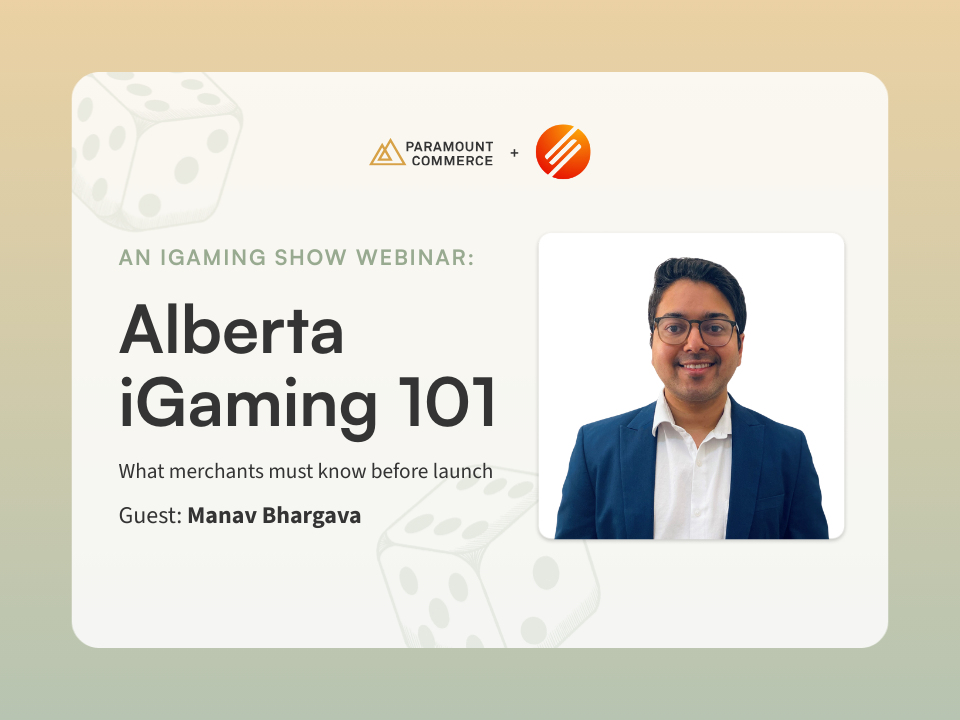
In this episode of The iGaming Show, Varad Mehta speaks with Manav Bhargava, Lawyer and Gaming Law Expert at Segev LLP, about Alberta’s iGaming framework, the roles of AGLC and Alberta iGaming Corporation, registration requirements, technical standards, responsible gambling, and the preparation involved before entering the regulated market.
Let us simplify payments for you today: https://www.paramountcommerce.com/book-a-demo
For pricing information, please visit: https://www.paramountcommerce.com/pricing
Learn about our Interac e-Transfer and Instant Bank Transfer solution
Alberta’s model involves two key provincial bodies: the Alberta Gaming, Liquor and Cannabis (AGLC) and the Alberta iGaming Corporation (AiGC).
Manav explains how the two organizations have different roles within the regulated framework and how private operators interact with each of them.
Alberta’s framework shares similarities with Ontario’s regulated iGaming model.
Both involve a regulatory body and a government entity responsible for conducting and managing the market. However, Manav highlights several differences, including security requirements and Alberta’s approach to centralized self-exclusion.
Entering a regulated market involves more than completing a registration.
The conversation covers several areas that operators need to consider, including:
Manav also explains why operators need to be able to demonstrate that their suppliers and technology meet the applicable requirements.
Responsible gambling and player protection are important parts of Alberta’s framework.
Manav discusses how Alberta expects operators to take a proactive approach rather than simply providing policies and player tools.
This includes monitoring for potential gambling-related harm and taking appropriate action when concerns arise.
Preparing for a regulated market requires coordination across legal, compliance, technology, product, and operational teams.
For operators entering from an existing regulated market, the process may involve adapting existing controls and procedures to Alberta's requirements.
For organizations transitioning from an unregulated or grey-market environment, the preparation can involve additional work around suppliers, affiliates, governance, policies, and operating controls.
Manav walks through the key areas that organizations should consider before launch, including:
Regulated iGaming involves more than an operator and a regulator.
Legal teams, suppliers, technology providers, affiliates, compliance teams, and other stakeholders may all have a role in preparing for the market.
Manav explains why organizations need to align these groups well before launch, particularly when transitioning from an unregulated environment.
Ontario and Alberta have taken similar approaches to regulated iGaming, but each province has its own requirements and framework.
The episode closes with a discussion about whether Alberta's model could influence other provinces and what the future of regulated iGaming in Canada could look like.
Transcript:
Varad Mehta: Alberta's iGaming market has been a key topic of discussion when it comes to iGaming in Canada. And now interest is growing further as Alberta's regulated iGaming space is set to launch this year. To understand what it takes to launch and operate legally within Alberta's iGaming space, we spoke with Manav Bhargava, Lawyer and Gaming Law Expert at Segev LLP. So without further ado, let's get the show rolling. Now moving into the topic of discussion, we're here to talk about Alberta's upcoming regulated iGaming space. Segev LLP has done a great job in putting together some great documents that would help a lot of people understand what the market is like and what the entry could be like. So beginning with just that idea, how does Alberta's new iGaming framework actually work? And what are the different roles of the provincial bodies that they set up that would be working with the iGaming market?
Manav Bhargava: So, yeah, thank you for the question. Essentially, Alberta has followed the Ontario model. To get into what it essentially is: in Canada, generally, all gaming is illegal except if it is conducted and managed by the provincial government or a provincial government body that has delegated the job. That is a very unique thing about Canada. That is why what iGaming operators or private iGaming operators get is a registration and not a licence. It is a registration because there are two bodies. One is the AGLC, which is Alberta Gaming, Liquor and Cannabis, and the other is Alberta iGaming Corporation. To put it simply, AGLC is the regulator and the gatekeeper. You apply for a registration with it. It does your background check. It not only registers operators, it also registers key suppliers, such as platform suppliers or game suppliers. Then it provides you a registration and ensures that you meet certain standards and requirements around certification of key gaming elements or key gaming software of your offering. The other body is the Alberta iGaming Corporation, which is the entity that conducts and manages the operation. Once an operator goes live, once an iGaming operator begins to offer their services, they work more closely with Alberta iGaming Corporation. It is the money-making body of the government. It supervises your operations on a daily basis to ensure that players are protected and the operator conducts itself in a way that complies with its rules and regulations. Those are the two bodies that work together in this framework. It is very similar to the Ontario framework where the AGCO, Alcohol and Gaming Commission of Ontario, and iGaming Ontario work together to supervise the operations of private operators.
VM: Yeah. And when the Ontario market launched, there wasn't as much information out there about how to move into a regulated space. But now that Ontario is set up, are there any steps from your perspective that market entrants should know if they want to move into Alberta? Maybe, or would it be a similar framework to what they worked on with the Ontario government?
MB: There are a couple of key differences, but it's largely similar. It's still the two government bodies where one is the regulator, and the other one is the one with which you enter into a commercial agreement, and that body conducts and manages the whole iGaming services that are provided by private operators. So it's very similar. Some things, of course, are a bit different from Ontario. For example, the security and infrastructure requirements are a bit more strict in Alberta. Before an operator launches their service, they need a SOC 2 Type 1 certification. After two years of the market going live, they would need a SOC 2 Type 2 or ISO 27001 certification. So that is a bit different. Another difference is that from the get-go operators would need to integrate with Alberta's self-exclusion programme. Ontario has just brought it in or is going to be introducing that soon. But in Alberta, operators are going to be a part of that programme from day one. That will require some engineering resources on the operator’s side; it's not just a policy matter.
VM: Are there any other approvals or steps that operators should have in mind, or should potentially work with legal professionals to sort out before the market launch?
MB: Before the market launch, of course, you'll have several steps. I was focusing on the differences between Ontario and Alberta, but the major steps involve first getting your registration, which includes your background checks. That means working with the due diligence team of AGLC, and then meeting all the technical requirements, ensuring that the games or the platform and the games you're using are certified. The platform you're using must have the relevant tools, including geo-blocking, responsible gambling tools, and tools that enable you to produce on-demand reports. There are essentially four or five important steps. The first one is the registration. This is where you decide your model: whether you're going to have one iGaming site or two iGaming sites, and you apply for registration depending on your needs. After that initial registration is done, you'll have to enter into a commercial agreement with Alberta iGaming Corporation. Before launch, you have to ensure that all your games are certified. Before they are deployed, they need to be certified by a testing lab. Right now, there are a lot of labs that are already registered in Ontario that are going to soon register in Alberta, and there will be new labs as well. Operators need to ensure that their game providers or content providers have certification from a testing lab that is registered in Alberta with the AGLC. The last step is to have a compliant operating model: to have your documented controls in place and your reporting system in place. If I had to boil it down, it would be registration with the AGLC, the contract with Alberta iGaming Corporation and ensuring you meet all obligations under that contract, having the tech certified, and having a compliant operating model. You would need legal advice and services at every stage of this. Even though certification of tech might not seem like something that an operator has to actively pursue, they must ensure that their vendor engagement policies and other controls are such that they can ensure, and can demonstrate, that they are not using any suppliers that are not registered or deploying any games that are not certified. Those policies must be not only implemented but documented in a way that allows AGLC to be assured.
VM: I think that's so interesting to know because I think people sometimes overlook these processes. People might just say, “Oh, it’s just a registration,” but there are so many technical requirements to get into a regulated space, which is why it's so important to know these things. You mentioned something interesting a couple of minutes back where you mentioned how Ontario has its own responsible gambling measures versus what Alberta has. In the conversation I had with Minister Dale Nally, as well as what was in the news, there’s a heavy emphasis on having a regulated space that has clear protection and responsible gambling at its core. So can you tell us what makes Alberta's responsible gambling measures a little bit different from Ontario's, or what they're doing in their own way?
MB: I think something that they are doing in their own way, or something that is a learning from what’s going on in Ontario, is that responsible gambling and player protection are not just policy talking points. It's not enough for operators to just have a policy. I think under the registrar’s standards that AGCO came up with, operators were given a lot of discretion on how to comply because the standards were not very prescriptive. The expectation was that operators would understand what was expected of them, but there was a bit of a gap between what the regulator expected and what operators thought they were expected to do. In Alberta, the province has clarified that they want operators to take a more proactive approach to responsible gambling. That means not only giving players tools such as loss limits and time limits, but also monitoring whether a player is becoming addicted to the platform or is facing gambling harms, and then intervening when necessary. Alberta does not just expect operators to have policies and tools, but also to intervene if they believe that a player is not using those tools and is facing gambling harms or becoming addicted to their services.
VM: For sure. I’d like to combine this question into two things, and we can fit it with the responsible gambling angle. In the first few days of operation or even before launching into the space, what are some concrete steps merchants should take? You mentioned the technical aspects and getting certain things checked with a legal professional such as yourself. What do the first 60 to 90 days look like for a merchant? What should they be prepared for? If there's a checklist, what would you say: “Don't overlook this. You need to check this and this”? It’s a big question, but I’d love to know your perspective.
MB: The first 90 days would look very different for someone who's already active in a regulated Grade A jurisdiction such as the UK, a U.S. state, or Ontario. That operator probably has a lot of controls in place and would just need to modify or beef up their controls and documented practices, policies, and procedures for Alberta. For someone that is new and entering the market from the grey market, it would look a lot different. First of all, Alberta has clarified that as soon as you launch in the regulated market, you should stop any activities in the unregulated market. For an operator to do that, it's not just ensuring that you stop offering in the market, but also ensuring that your suppliers are not offering their services to the unregulated market. That must be ensured through contractual obligations in agreements with suppliers and affiliates that assist with marketing. So, for a new operator, the first 15 days would involve identifying how they will structure the entity that will apply for registration, who the key people in that entity will be, and who will be responsible for the entity: the board, the chief technology officer, and the C-level roles. They have added obligations and would need to go through a due diligence process with AGLC. They would start working toward building and operating a compliant operating model. They would have to decide whether they will have one website or two websites, or two brands—a different brand for sportsbook and a different brand for casino—and how their services will look. Depending on that, they would seek registration. Two websites could sometimes mean having two different applications and paying the registration fee twice. Those are important questions. Next, Alberta will require a gap analysis, much like Ontario does, where you look at the standards and requirements for the market and compare them to your existing product, governance structure, and policies and procedures. You then decide whether you meet those standards. If you don’t, you must plan how to meet those standards and requirements. After that exercise, you look at your policies and procedures and beef them up as needed, modifying them to suit the needs of the Alberta market. Once you've done this, you move toward registration: have your people and your team ready, have all the documents needed for registration ready, and have your team prepared for background checks—not just for your company, but also for key people. Ensure that your vendors and suppliers are ready and already registered. If one of your key suppliers isn’t registered, then you must ensure that while you are registering with AGLC, they also begin their registration process. It would be very disappointing to find out that a key supplier is not registered for the market and cannot support you in this new market. The next step is ensuring your lab certifications and security testing are done. Then you ensure that you have all the product controls: geo-fencing for Alberta, responsible gambling tools, player protection tools, and your AML and KYC tools in place. In the last 45 days, you ensure that your control activity matrix—an important document, similar to Ontario’s—is being audited. That matrix ensures all your controls are in place and you’re ready to go live. Finally, you go live, ensuring that once you do, all your people are on the same page, you’ve done your testing, you can produce reports as needed, and you can comply with all your obligations under the agreement with AGLC and other policies and procedures related to AML and KYC. The last 30 to 45 days is really about testing how robust your product is and ensuring that it complies with everything you need to comply with once you go live. Once you go live, any issues could lead to non-compliances and invite sanctions—not necessarily the first time, but you do not want the regulator to think that you do not have enough checks and balances in place to run a compliant offering. It’s not only about sanctions; it's also about losing trust with your players and the regulator.
VM: I mean, based on how much you've just mentioned, that 90 days seems like a lot. So my follow-up question is: how important is collaboration during this process? A merchant might feel more at ease knowing they have someone who can support them during the first 90 days and prior to that. I’m sure it's not just the first 90 days; it’s maybe a six-month-long process that you're already working on in the background. How important is collaboration between you, affiliates, merchants, and regulators within the province?
MB: Exactly. We, as a firm, were involved with AGLC in giving feedback when this regime was being built. We already recognised and provided feedback on issues that could impede the growth of the market. So collaboration is very important. We say this a lot to operators that do not have experience in Grade A jurisdictions: if you use us, it might add to your compliance costs, but it would certainly be more expensive and time-consuming if you try to figure out everything yourself. It’s really important that you collaborate with the right people and have your suppliers aligned. Especially for operators that were in the unregulated market and work with suppliers and marketing affiliates that are only used to working in the unregulated market, an operator moving into this space needs to understand that it's not just a transition. It's actually a switch-off and then, very carefully, a switch-on into a new regime. For example, the standards require operators not to work with any suppliers and affiliates that are still servicing the unregulated market through other clients. It's very important to have contractual obligations in place that allow you to exit relationships if such a thing happens. It's better to prepare beforehand. As you said, collaboration is not just about the first 90 days of launch. It's probably 90 days or even eight to ten months before your launch.
VM: Right. And sorry, just breaking in there. I was just about to ask you what people overlook, but there’s the answer itself. Collaboration between people who know the market or are experts within the Canadian market, and who can help guide you in tackling these complicated processes, would be the best way, right? That’s the best way to say it.
MB: Yeah. As I said, it depends on your team and how experienced they are. Canada is its own jurisdiction. The Ontario iGaming regime and Alberta iGaming regime have a lot of similarities but are also unique in their own ways, especially in the controls, procedures, and policies that you must have in place. As opposed to other jurisdictions where what you get is a licence, there is a reason why it is called a registration here. The two bodies, AGCO and Alberta iGaming (and, in Ontario, iGaming Ontario), supervise you more than another regulator in another jurisdiction might. They’re more involved because of their mandate to conduct and manage the operations. You could think of a private operator as working as a sub-licensee, if I may say so, for Alberta iGaming and iGaming Ontario. That is why, in Ontario, taxes such as HST are paid by iGaming Ontario on behalf of operators, because it is the one that is offering these services. Operators are offering services under the supervision of iGaming Ontario.
VM: Got it. Okay. That's actually really helpful to understand as well. That was a really good point. My last question for you, Manav, is that last year there was some talk about Alberta's iGaming space, but now this year it seems like something will definitely happen. With this market launch coming up, do you expect more markets to open up within Canada soon? How optimistic are you that work is not going to be short for you in the next few years as more markets open up? Do you see any ripple effect—after Ontario it’s Alberta; after Alberta, do you think it's going to be something else? It sounds silly when I say that because Alberta is not ready yet, but I'm already asking, “What's next?”
MB: Seeing the success of the Ontario market—Ontario has one of the biggest markets in North America now, or I believe it's the biggest market in North America—and seeing that success and Alberta following the Ontario model, which is a great model that on one side promotes growth and on the other side has all the checks and balances for player protection that did not exist in the unregulated or grey market space, I think we will see other provinces following. They might adopt a similar model or a different model that works for them, while keeping in mind the conduct and manage mandate. We could see other provinces follow suit. It would be interesting to see. Right now, naming a province would just be speculation, but I believe one or two of the bigger provinces in terms of population may follow.
VM: There you go. You have it. Manav, I want to thank you so much for joining us today. As I mentioned, this topic has been spoken about for two or three years, but I’m so happy that we could have it in this format. For anyone who is moving into the Canadian space or wants to better understand the Canadian space when it comes to regulated iGaming, this will serve as the content piece they can take everything from. You are such a wonderful expert who really helped us understand the intricacies and what is involved, and what people shouldn’t overlook when it comes to iGaming in Canada. So I want to thank you so much. I know it must be a super busy time for you and your team. Thank you so much for taking the time to speak to us today. It was truly wonderful to learn from you.
MB: It was great talking to you, Varad. Thank you for reaching out. I'm really glad that I could contribute and help anybody who's looking to enter the market. Thank you.
VM: Thank you. I want to thank Manav Bhargava, lawyer and gaming law expert at Segev LLP, for joining us today and providing his expertise on Alberta's upcoming regulated iGaming market. If you have any questions for us or Manav, please comment down below. Don't forget to like and share this episode and subscribe to our YouTube channel. Thank you so much for tuning into The iGaming Show presented by Paramount Commerce. I'm your host, Varad Mehta. And until next time, keep gaming.
Fintech trends and insights,
explained in 5 minutes or less

Fintech trends and insights,
explained in 5 minutes or less