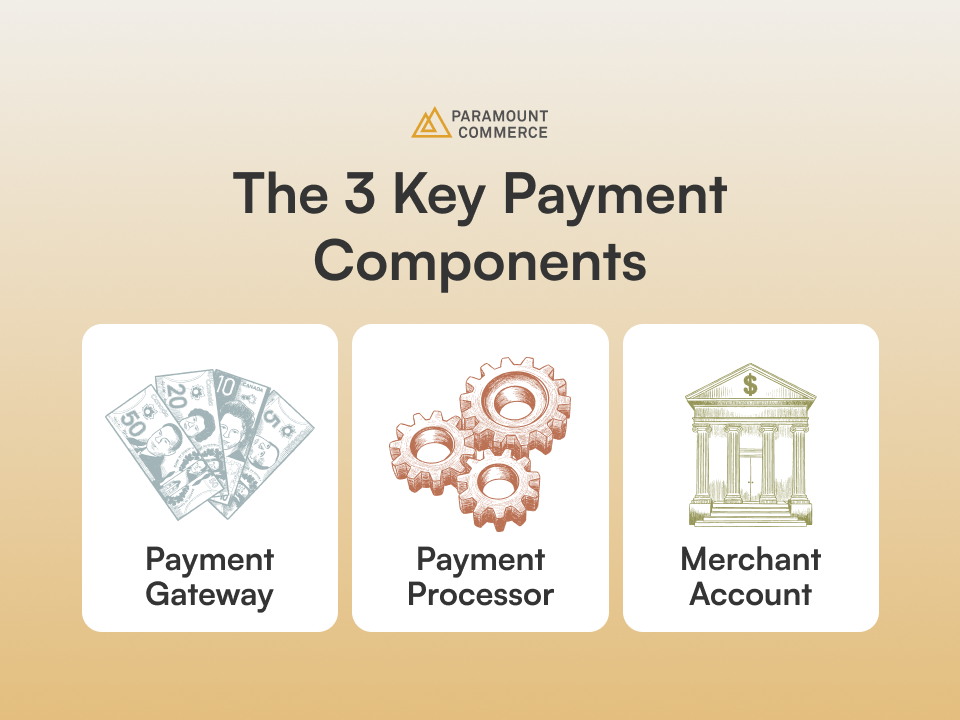


Understanding the differences between a payment gateway, payment processor, and merchant account is crucial for any Canadian business looking to accept electronic payments. These terms are often confused, but each plays a unique role in the payment process. Let’s break them down with clear definitions and Canadian examples.
A payment gateway is the technology that securely captures and transmits payment information from the customer to the payment processor. Think of the gateway as a digital bridge or tunnel, encrypting sensitive card or bank details during online (and sometimes in-person) checkout.
Analogy: If online payments are like trains, the payment gateway is the set of tracks connecting the customer to the station.
Key features:
Canadian examples:
A payment processor is the company responsible for securely managing and completing the transaction, ensuring money moves from the customer to the business.
Unlike gateways (which focus on data transmission), processors handle the actual movement of funds through different payment rails. This includes credit and debit card networks, as well as bank-based rails such as Interac e-Transfer® and EFT (Electronic Funds Transfer).
For card payments, the processor works with banks and card networks to verify and settle transactions. For pay by bank payments, the processor connects directly with participating financial institutions to transfer funds securely, often in real time, without the need for card networks or authorization holds.
Analogy: The processor is like the signal operator that makes sure every train arrives safely and on time.
Key features:
Canadian examples:
A merchant account is a specialized bank account where customer funds are held after payment approval but before they are deposited into your regular business account. This ensures payments clear before releasing the money to the merchant.
In the case of card transactions, funds are typically held for settlement before being released. For pay by bank payments, funds are usually deposited directly into your business account once the transaction is confirmed, so in some cases, a separate merchant account isn’t required.
Analogy: Think of the merchant account as the station where fare is collected before being transferred to your business's main vault.
Key features:
Canadian examples:
Fintech trends and insights,
explained in 5 minutes or less

Fintech trends and insights,
explained in 5 minutes or less